
You are on a ladder with a fitting in one hand. The phone buzzes. It is the third “Google specialist” this week. He says your listing is “not optimized” and he can fix it for a small monthly fee.
Maybe he is right. Maybe he is reading from a script. You can’t tell, because nobody ever explained what local SEO actually is.
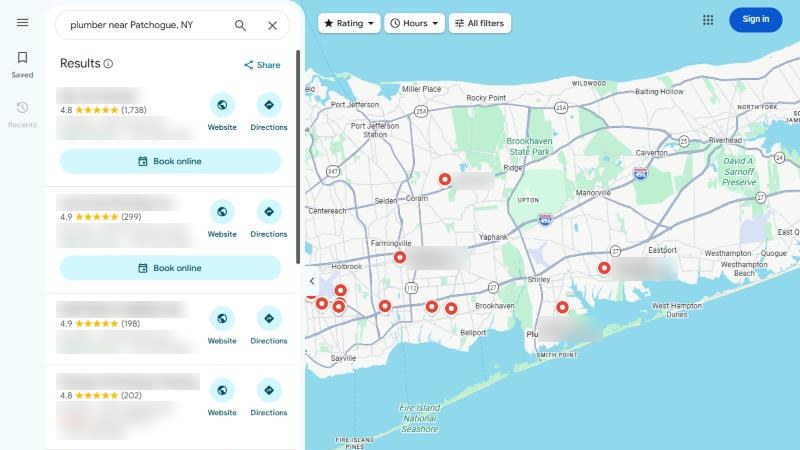
So here it is in plain words. Local SEO is the work that decides whether your business shows up when someone nearby searches for what you do. Mostly that means the map with three businesses on it, and the plain list of websites under it.
Short answer
For a plumber, HVAC company, roofer or electrician, four things do most of the work: a complete Google Business Profile with the right categories, a steady flow of real Google reviews, a website with one page per main service and the cities you serve, and the same name, address and phone on every listing. Distance to the searcher matters a lot too, and you can’t change it. Google says you can’t pay for a better local ranking, so be wary of anyone who sells one.
direct connections a month between people and American businesses through Google in 2025: calls, direction requests, messages, bookings and reviews (Google, U.S. Economic Impact Report, 2025).
How Google says it picks local results
Start with the source. Google has a help page called “Tips to improve your local ranking on Google.” It says local results are mainly based on three things:
- Relevance: how well your profile matches what the person searched for. “Water heater repair” needs a profile that clearly does water heaters.
- Distance: how far you are from the person searching. You can’t move your shop for SEO, so don’t waste a minute worrying about it.
- Prominence: how well known you are. Google says this is based partly on how many websites link to you and how many reviews you have, and that more reviews and good ratings can help.
The same page says, in plain words, that there is no way to request or pay for a better local ranking. Google Ads can buy you a spot marked “Sponsored.” They don’t buy you a better spot in the free results.
That is the whole official rulebook. It is short on purpose. For more detail, people in the trade lean on one survey.
What 47 local search experts rank highest
Whitespark, a Canadian local SEO company, runs a survey that asks the people who do this work all day to score what matters. The 2026 edition came out on 6 November 2025. 47 experts scored 187 factors.
Keep in mind what it is: expert opinion, not Google’s code. Nobody outside Google sees the real formula. But when dozens of people who test this for a living agree, it is worth listening.
The map results (the “3-pack”)
At the top of the experts’ list for showing up on the map:
- Your primary category on your Google profile. This sat at the very top of the list.
- How close you are to the person searching.
- Keywords in your business name. This one comes with a big warning, below.
- Having an address in the city being searched.
- Being open at the time of the search.
- A high star rating (4 to 5 stars).
Close behind: showing your address, your additional categories, the number of Google reviews with text, and having your map pin in the right spot.
Now the warnings. Yes, keywords in the business name help. But Google’s rules say your name must be your real-world name, the one on your truck and invoices. Adding “Best Emergency Plumber Phoenix” to it breaks those rules and can get your profile suspended. If your legal name is “Mesa Drain and Sewer,” lucky you. If it is “Johnson and Sons,” leave it.
The same goes for the address factors. If customers don’t come to you, Google’s rules say to hide your address and set a service area. Don’t rent a mailbox or a fake office to look local. Google says a service business can’t list a virtual office unless it is staffed during business hours.
The regular search results under the map
For the plain list of websites, the experts put different things on top:
- A dedicated page for each service.
- Content that names your cities and neighborhoods.
- Good links to your site from real, trusted websites.
Then keywords in your page titles and headings, links from sites in your own trade, and a website focused on one kind of work.
AI answers
This edition also scored what helps a business show up in AI answers like ChatGPT and Google’s AI. The top of that list: being named on trusted “best of” lists, a dedicated page for each service, and being mentioned on respected sites in your industry. We cover this in how ChatGPT picks which local businesses to recommend.
The four pieces that do most of the work
Put Google’s page and the survey side by side and the same four things keep coming up. Do these well and you have done most of local SEO. Skip them and nothing else will save you.
1. Your Google Business Profile
This is the box with your name, stars, hours and the “Call” button. It is free, and it is the biggest single lever you have.
- Primary category: pick the one service you most want calls for, named the way customers search. “Plumber,” “HVAC contractor,” “Roofing contractor,” “Electrician.”
- Additional categories: add every one that truly fits, the other kinds of work you do. Never add one for work you don’t do.
- Services: under each category, tick every service you actually do.
- Hours: keep them true, holidays included. “Open now” is one of the top factors.
- Photos: real jobs, your truck, your team. Not stock photos.
We go step by step through all of it in how to rank in Google Maps as a plumber, HVAC company or roofer.
2. Reviews
Google names reviews in its own ranking page. The experts put star rating and review count in their top ten. Reviews also decide whether someone calls you or the next name down.
The work is boring and it works: ask every customer, every time, with a direct link. Reply to every review. Never pay for reviews and never ask “were you happy?” first and only send the link to the ones who say yes. Our post on why people trust Google reviews explains what customers look for.
3. Your website’s service and city pages
Your Google profile links to your website, and Google reads it. One long “Services” page that lists twelve things in a row gives Google very little to match.
What helps: one page per main service (“Drain cleaning,” “Tankless water heaters,” “Panel upgrades”), each with real details, photos and the cities you do it in. If one city brings in a lot of work, give it its own page with real jobs you did there. Never copy the same page and only swap the city name. Google treats that as spam.
The page also has to load fast on a phone, or people leave before they read it. See what page speed is and how slow is too slow.
4. Listings and links
Your business also lives on Yelp, Bing, Apple Maps, Facebook, the BBB and a pile of directories you never signed up for. These are called citations. The experts disagree on how much they still matter for ranking. Some call them a foundation. Some say they are almost a non-factor now. Several said they matter more for AI answers.
Everyone agrees on one point: your name, address and phone should match everywhere. Fix the big ones once, do it right, and move on. Our guide to NAP consistency shows how to find and fix mismatches.
Links are different. A link from your local supply house, a trade association you belong to, a Little League team you sponsor, or a news story about your work is worth more than a hundred junk directory listings.
Not sure where your business stands on these four? Our free audit checks your Google profile, reviews, website speed and listings against your top local competitors.
What you can safely ignore
The same survey asked the experts which popular ideas are myths. A few that contractors get sold all the time made that list:
- Geo-tagged photos. Adding GPS data to your photos was the top myth.
- Social media follower counts and how often you post on Facebook or Instagram.
- Spending on Google Ads to help your free ranking.
- Keywords in your replies to reviews and in your Google profile description.
- Lots of Google profile posts. Posts can help a customer decide. The experts don’t think the number of them moves your ranking.
- Keywords stuffed into image file names, meta descriptions and other hidden places.
The 2026 survey also listed things that can hurt you or get you suspended. The two the experts rated riskiest: showing your address when you are a service-area business, and setting a service area bigger than about two hours’ drive. Also on the list: stuffing keywords into your profile or posts, and AI-made photos. If someone offers to “add 50 cities to your service area,” say no.
Two things that aren’t SEO but decide whether it pays
Ranking only gets the phone to ring. Two more things decide whether that turns into a job.
Answering the phone. Showing up on the map and then sending callers to voicemail is like buying a billboard and painting over the phone number. If you are on a roof all day, read what a missed call really costs.
Showing up outside Google. Your customers also ask ChatGPT and Apple Maps. In BrightLocal’s 2026 survey of 1,002 US adults, 45% said they had used AI tools like ChatGPT for local recommendations, up from 6% a year before. The good news: the same four pieces above help there too.
Do you even need this?
Fair question. If your schedule is full from word of mouth, you may not need much. But even referred customers usually look you up before they call. We wrote a straight answer to whether you need SEO if referrals keep you busy.
And if you wonder how many people actually find local businesses this way, we pulled together what Google and the big surveys say about Google Maps use, with dates on every number.
How long does local SEO take?
Honest answer: nobody can give you a date, and anyone who promises one is guessing. Fixing a wrong category or wrong hours is quick work, and Google picks up the change on its own schedule. Reviews and website pages build up slowly, a few at a time. Distance never changes.
That is also why nobody can promise you a ranking. What you can control is how complete, accurate and well reviewed you are. Do that better than the shop down the road and the odds lean your way.
Do this this week
- Search your main service and city on your phone, like “water heater repair Mesa.” Write down the three businesses on the map and their primary categories.
- Open your Google Business Profile. Check your primary category, add every additional category that truly fits, and tick every service you do.
- Fix your hours, including holiday hours.
- Check that your business name on Google is your real name, with no extra keywords.
- Text your last five customers your direct Google review link.
- List your main services. Does each one have its own page on your website? Write down the ones that don’t.
Common questions
Is local SEO worth it for a small contractor?
Most of it costs time, not money. A complete Google profile, real reviews and accurate listings are free. Whether to pay someone depends on how much your time is worth and how busy you already are.
Can I pay Google to rank higher on the map?
No. Google’s own help page says there is no way to request or pay for a better local ranking. Ads show in a separate spot marked “Sponsored.”
Do I need an office in every city I serve?
No, and don’t fake one. If customers don’t visit you, Google’s rules say to hide your address and set a service area. Virtual offices are only allowed if they are staffed during business hours.
Should I put keywords in my business name?
Only if they are really part of your name. Google’s guidelines say your name must match the one you use on signs and paperwork. Added keywords can get your profile suspended.
Do Google profile posts help my ranking?
The experts in Whitespark’s 2026 survey listed the number of posts as a myth for ranking. Posts can still help a customer choose you, so post when you have something real to show.
If you want a second pair of eyes before you spend money on any of this, start with our free audit. You will see how your profile, reviews and website compare with the businesses already on the map. What we offer after that is on our packages page.
Sources
- Google Business Profile Help, “Tips to improve your local ranking on Google,” read 12 November 2026. support.google.com/business/answer/7091
- Google Business Profile Help, “Guidelines for representing your business on Google,” read 12 November 2026. support.google.com/business/answer/3038177
- Whitespark, “2026 Local Search Ranking Factors,” Darren Shaw, published 6 November 2025 (survey of 47 experts, 187 factors). whitespark.ca/local-search-ranking-factors
- Google, U.S. Economic Impact Report 2025, read 12 November 2026. economicimpact.google
- BrightLocal, “Local Consumer Review Survey 2026,” 11 February 2026, 1,002 US adults. brightlocal.com/research/local-consumer-review-survey