
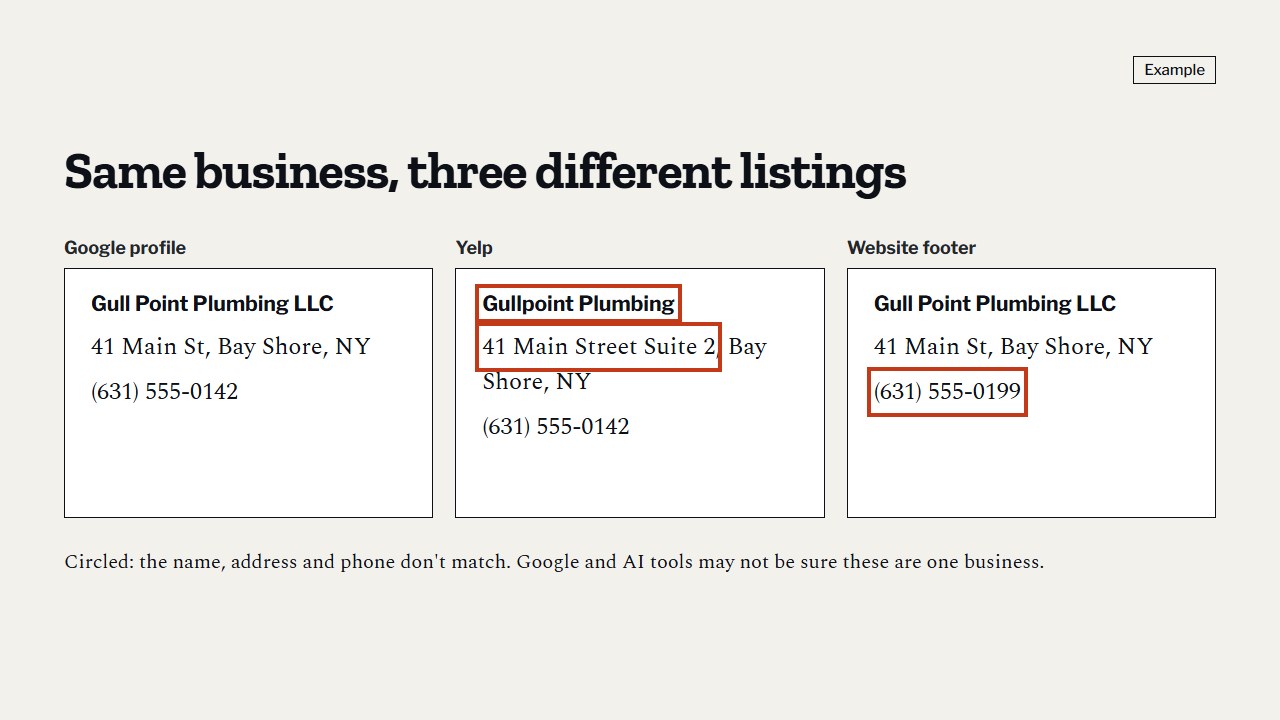
A homeowner finds you on Yelp. Good reviews, nice photos of a clean water heater install. She taps “Call.”
A dog groomer answers. That was your number in 2019, before you switched to a new cell plan. She hangs up, goes back, and calls the next plumber on the list.
You never knew that call happened. That is the problem with wrong listings: they cost you jobs quietly.
Short answer
NAP stands for name, address and phone number. NAP consistency means your business shows the same name, address and phone on every site that lists you: Google, Apple Maps, Bing, Yelp, Facebook, the BBB and the data companies that feed many smaller directories. Mismatches usually come from old phone numbers, old addresses and switching between your legal name and your trade name. Pick one official version, fix the big sites first, and let the data companies spread it to the rest.
What NAP means, exactly
NAP is short for Name, Address, Phone. Most people now add your website too. Every place these appear online is called a citation: a directory listing, a map app, a Facebook page, your local chamber’s member list.
“Consistent” means a customer, or a computer, can tell they are all the same business. It doesn’t mean every comma must match. “Suite 4” and “Ste 4” are the same place, and nobody is losing calls over it. What matters is the stuff that sends people to the wrong place:
- A phone number that no longer rings you.
- An address you moved out of.
- A name that doesn’t look like the one on your truck.
Why it matters
Customers use more than Google now
In BrightLocal’s February 2026 survey of 1,002 US adults, the average person used six different review sites, and Apple Maps use nearly doubled in a year, from 14% to 27%. A wrong number on any one of those is a lost call.
Google wants your real-world name
Google’s guidelines for Business Profiles say your name should match how your business is consistently known in the real world: on your signs, your stationery and your other branding. The phone number must connect to your business and be under your direct control.
Search engines and AI tools compare sources
Will fixing your listings shoot you up the map? Probably not on its own. In Whitespark’s 2026 Local Search Ranking Factors survey, the 47 experts disagreed on citations. Some called them a foundation. Others said they matter less every year. Several thought they matter more for AI answers, since ChatGPT and other AI tools read Bing, Yelp and other directories.
One expert, Miriam Ellis, made the point well: don’t skip basic consistency just because you hear it isn’t a ranking factor. A wrong number is a business problem before it is an SEO problem. For more on where AI tools look, see why Bing and Apple Maps matter for contractors.
Where mismatches come from
Almost nobody types a wrong listing on purpose. They pile up over the years, like old paint cans in the garage.
- Old phone numbers. You switched carriers, dropped a landline, or moved from your personal cell to a business line. The old number lives on in every directory that copied it.
- Call tracking numbers. An old ad campaign or lead service gave you a tracking number. Directories picked it up. The campaign ended; the number stayed.
- Moved shops. You moved from a rented unit to your own yard, or started working from home. Old listings still show the old place.
- Legal name vs trade name. Your LLC is “R. Delgado Mechanical LLC” but your truck says “Delgado Heating and Air.” Some sites got the first, some the second.
- Your home address showing. Plenty of contractors started at the kitchen table and listed their home address. If customers don’t visit you, Google’s guidelines say to hide your address and set a service area instead. Old directories may still show it.
- Data companies spreading old info. A few large data companies sell business listings to many smaller sites. If they have an old record, it keeps coming back like a weed.
- Other people’s edits. Anyone can suggest changes to a Google or Apple listing. Most are helpful. Some aren’t.
How to find your mismatches
No paid software needed. Give it twenty minutes and a coffee.
- Write down every phone number and address you have ever used for the business, and every version of the name.
- Search each old phone number on Google in quotes, like “(480) 555-0142”. Every result that shows up is a listing to fix.
- Search your business name with your old city or street.
- Check the big sites by hand: Google, Apple Maps, Bing, Yelp, Facebook, the BBB and Nextdoor if you use it.
If you would rather have someone else do the digging, our free audit checks your main listings and flags the ones that don’t match.
How to fix them, in the right order
Order matters. Fix the source first, or the wrong data keeps flowing back in.
Step 1: Pick your one official version
Write down exactly how your name, address and phone should appear, and use it everywhere. Use the name on your truck and signs. Use one main business phone number, not a tracking number. If you are a service-area business, decide whether your address is hidden.
Step 2: Google Business Profile and your website
Fix your Google profile first. Then make your website match it, especially the footer and contact page. These two are the reference everything else is checked against.
Step 3: Apple Business (formerly Apple Business Connect)
This is what shows up in Apple Maps and Siri on iPhones. Apple renamed the tool in 2026: Apple Business Connect became part of a free service called Apple Business, which launched on 14 April 2026. Apple says existing claimed locations moved over on their own, so if you claimed your listing before, log in and check it is still right.
Step 4: Bing Places for Business
Microsoft relaunched Bing Places in October 2025 at bing.com/forbusiness, with a better way to import your details from your Google profile. Import, then check every field by hand. Bing matters because ChatGPT’s web searches lean on it.
Step 5: Yelp, Facebook and the BBB
Claim your Yelp business page and fix your name, phone, address and categories. One rule to know: Yelp’s own guidelines tell businesses not to ask anyone for Yelp reviews, so don’t. Then update your Facebook page’s contact details, and your BBB profile if you have one.
Step 6: The data companies
These are the wholesalers of business data. Fix your record with them and the change spreads to many smaller sites over time. BrightLocal’s guide, updated July 2026, lists these for the US:
- Data Axle (formerly Infogroup).
- TransUnion Digital Business Profile (formerly Neustar Localeze). TransUnion launched it for small businesses in April 2026 as a paid yearly plan.
- Foursquare, which merged with Factual in 2020. You can search for your business and claim it on Foursquare’s business portal.
Step 7: Stop there
You don’t need 300 directory listings. Fix the big ones once, do it right, and move on. Paid packages that blast your business to piles of tiny directories are mostly a way to sell you something every year. Spend that time on the parts of local SEO that actually move the needle instead.
Do this this week
- Write down your one official name, address and phone.
- Google every old phone number you have used, in quotes. List each site that still shows it.
- Check Google, Apple Business, Bing Places, Yelp and Facebook. Fix anything that doesn’t match.
- Make sure your website footer matches your Google profile exactly.
- Put a reminder in your calendar to check again whenever you move or change numbers.
Common questions
What does NAP stand for in SEO?
Name, Address, Phone number. Many people also include your website. NAP consistency means those details match on every site that lists you.
Does NAP consistency still matter in 2026?
For customers, yes: a wrong number is a lost call. For ranking, the experts in Whitespark’s 2026 survey were split, and several said consistent listings matter more now for AI tools.
I’m a DBA. Which name do I use?
Use the name customers know you by, the one on your truck, signs and invoices. Google’s guidelines ask for your real-world name as you use it consistently. Just use the same one everywhere.
Can I use a call tracking number on Google?
Google says the number must connect to your business and be under your direct control. Many owners keep their main number on every listing so everything matches. If you use tracking, ask how it will show on other sites before you switch.
How long until fixes show up everywhere?
The big sites show changes once they accept them. Smaller directories update when they next pull from the data companies, which can take a while, so check back later.
Customers who find you on the map also check other places before calling. Read how many people use Google Maps to find local businesses, and if your work mostly comes from word of mouth, whether you need SEO if referrals keep you busy.
Want us to check your main listings for you? Start with our free audit. What we offer after that is on our packages page.
Sources
- Google Business Profile Help, “Guidelines for representing your business on Google,” read 12 November 2026. support.google.com/business/answer/3038177
- Whitespark, “2026 Local Search Ranking Factors,” published 6 November 2025 (47 experts; expert Q&A on citations). whitespark.ca/local-search-ranking-factors
- BrightLocal, “Local Consumer Review Survey 2026,” 11 February 2026, 1,002 US adults. brightlocal.com/research/local-consumer-review-survey
- BrightLocal, “Data aggregators” guide, last updated July 2026. brightlocal.com/learn/local-citations/data-aggregators
- Apple Newsroom, “Introducing Apple Business,” 24 March 2026. apple.com/cm/newsroom/2026/03/introducing-apple-business
- Search Engine Journal, “Microsoft launches new Bing Places for Business,” Matt G. Southern, 3 October 2025. searchenginejournal.com/microsoft-launches-new-bing-places-for-business
- Digital Commerce 360, “TransUnion launches Digital Business Profile,” 28 April 2026. digitalcommerce360.com/2026/04/28/transunion-launches-digital-business-profile-search
- Foursquare Support, “Claiming a listing,” read 12 November 2026. support.foursquare.com
- Data Axle, Local Listings documentation, read 12 November 2026. local-listings-premium.data-axle.com/docs
- Yelp Support, “Don’t Ask for Reviews,” read 12 November 2026. yelp-support.com/article/Don-t-Ask-for-Reviews