
It’s 9 p.m. in July and the AC just died. The homeowner is sweating on the couch, phone in hand, searching “AC repair near me.” Three companies show up on the map.
One has a 4.8 with 212 reviews. One has a 4.2 with 18 reviews, the newest from 2023. One has a perfect 5.0 from three people. Nobody in that house has met any of these companies. They will still pick one in about a minute, and the reviews will do most of the deciding.
This post is about why. If you understand what is going on in that customer’s head, you know which reviews matter, which ones don’t, and what to do about the bad ones.
Short answer
People trust strangers’ reviews because hiring a contractor is a guess, and other people’s experience is the best proof they can get. They give bad reviews more weight than good ones, they trust a strong real rating (around 4.5 and up) more than a too-perfect one, and most of them look for reviews from the last few months. So the goal is a steady stream of fresh, honest reviews, with a calm reply to every one.
of US consumers read reviews when looking at local businesses (BrightLocal Local Consumer Review Survey, February 2026, 1,002 US adults).
Why people trust reviews from strangers
Psychologists have a name for it: social proof. When we aren’t sure what to do, we look at what other people did and copy them. It’s why a busy taco truck gets busier.
Hiring a tradesperson is about as unsure as buying gets. You can’t test-drive a water heater install. You can’t see inside the wall. The customer can’t tell good wiring from bad. So they borrow the judgment of people who have already been through it.
BrightLocal’s 2026 survey of 1,002 US adults found that 49% trust online reviews as much as recommendations from people they know. Half your market treats a stranger in your town like a friend’s tip.
That trust turns into action. In the same survey, 54% said they go to the business’s website after reading positive reviews.
Why one bad review hurts more than one good review helps
Here’s the part owners hate. The brain weighs bad news more heavily than good news. Researchers call this negativity bias, and it shows up in reviews too.
Economists Judith Chevalier and Dina Mayzlin studied book reviews and sales on Amazon and Barnes & Noble. Their 2003 paper for the National Bureau of Economic Research found that the effect of a 1-star review on sales was bigger than the effect of a 5-star review. Books aren’t boilers, but the pattern fits what local customers say.
In BrightLocal’s 2026 survey, 85% said positive reviews make them more likely to choose a business, and 77% said negative reviews make them less likely. Both matter. The bad one just shouts louder.
What this means for you:
- You can’t bury a bad review with one good one. You need a steady flow of good ones around it.
- The reply matters as much as the review. A calm, specific answer turns “this company is bad” into “this company had a bad day and fixed it.” We show how in how to reply to a bad Google review.
Why a 4.7 can beat a perfect 5.0
You’d think a perfect score wins. Often it doesn’t.
Northwestern University’s Spiegel Research Center looked at online shopping data and found that the chance of buying peaks for ratings between 4.0 and 4.7, then drops as the rating gets close to 5.0. The peer-reviewed paper behind it, by Ewa Maslowska and colleagues in the International Journal of Advertising (2017), put it simply: more positive ratings don’t always mean more sales. The researchers’ explanation: a perfect score can look too good to be true.
Two honest notes. That research used online product sales, not contractor calls. And the data is from 2017. But the idea holds up in everyday life. If a roofer has 40 reviews and every one is five stars with one line of praise, a careful homeowner starts wondering who wrote them.
So don’t panic about the odd 4-star review. It makes the rest more believable.
But there is a floor
Don’t take that as a reason to relax. Customers have a cut-off, and it’s getting stricter.
of consumers will only use a business with 4 stars or more, up from 55% a year earlier. 31% want 4.5 or more (BrightLocal Local Consumer Review Survey, 2026).
Put those two findings together and you get a clear target: a real, mixed rating comfortably above 4.5, not a suspicious 5.0 and not a shaky 4.1. Back to our sweaty homeowner: the 4.2 with 18 reviews just lost a third of the people looking at it.
Why fresh reviews beat old ones
A review is a snapshot. Customers know a company can change: the owner retires, the good tech leaves, the new crew cuts corners.
BrightLocal’s 2026 survey found that 74% of consumers look for reviews written in the last three months. 32% want reviews from the last two weeks, up from 20% the year before. Being “posted within the last month” was one of the top things that made a review feel trustworthy, picked by 44%.
The experts agree. Whitespark’s 2026 Local Search Ranking Factors survey asked 47 local search specialists what moves a business up in Google Maps. “Recency of reviews” ranked 11th in their list, and a “sustained influx of reviews over time (rather than bursts)” ranked 14th. That is expert opinion, not Google’s own word, but it matches what customers say.
That’s why the 212-review company with nothing new since spring can lose to a smaller company that got four reviews last week. An old pile of reviews looks like a business that stopped.
The fix isn’t a big push once a year. It’s asking every customer, every job, so reviews keep coming. Our guide to asking for Google reviews without being pushy has the exact words to use, in person and by text.
Your replies are part of the review
Customers don’t just read reviews. They read how you answer them.
BrightLocal found that 89% of consumers expect business owners to respond to reviews. 80% said they are likely to use a business that responds to all its reviews, and 42% are unlikely to use one that never replies.
But copy-and-paste doesn’t count. The same survey found that templated or generic replies put off 50% of consumers. “Thanks for the review!” fifty times in a row reads like nobody is home.
Google says the same in its own help pages: avoid sending the same thank-you to everyone, keep replies short, use the reviewer’s name, and apologize when it’s right to.
What makes one review more believable than another
Not every review carries the same weight. BrightLocal asked people what makes a review trustworthy. The top answers:
- The reviews agree with each other (56%).
- The written review describes a good experience (46%).
- It was posted within the last month (44%).
- A high star rating (42%).
- The owner responded (37%).
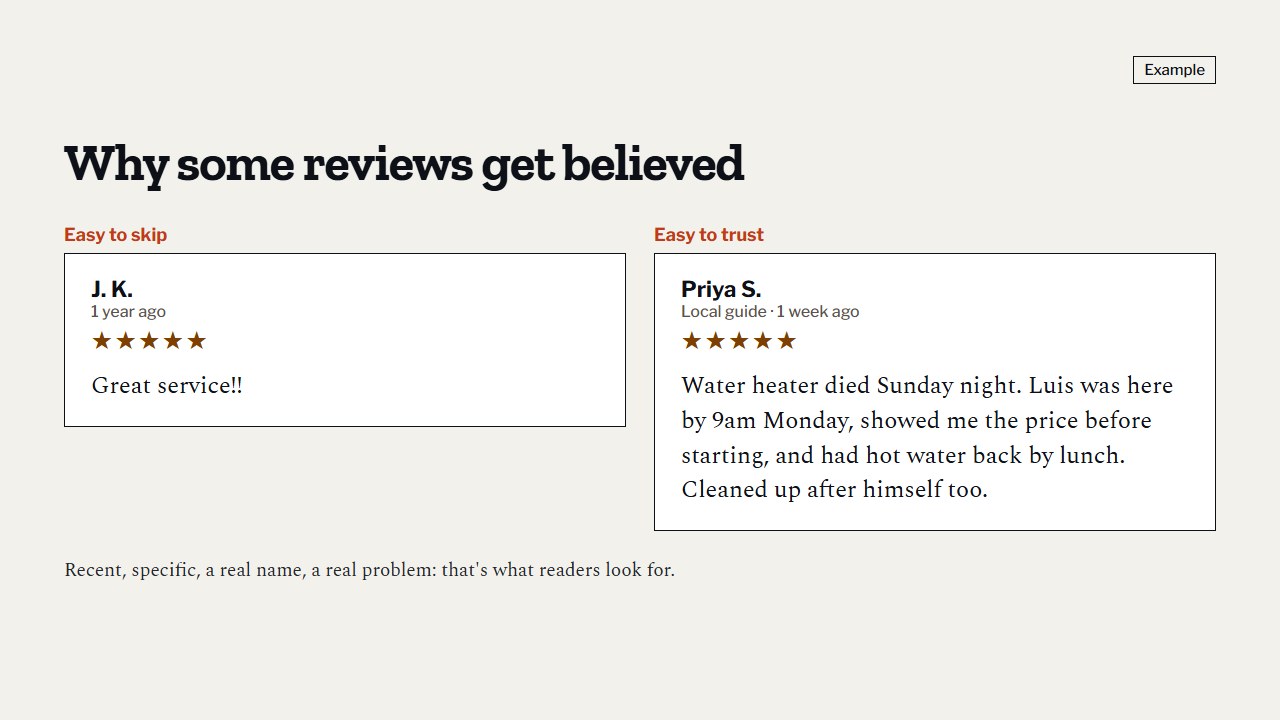
Notice what’s at the top: consistency. If twenty reviews say “on time, explained everything, cleaned up after,” the reader believes it. That’s a picture of your business, written by your customers.
You can’t tell customers what to write. Google’s rules ban asking staff to get reviews with specific content, including naming a staff member. But you can do the work that gets written about. Show up when you said. Explain the price before you start. Put down drop cloths. Customers write about what they notice.
Curious how your reviews stack up against the companies you lose jobs to? Our free audit puts your rating and review count next to your nearest competitors’ review counts, so you can see the gap.
How many reviews is enough?
There’s no magic number, but there is a floor. BrightLocal’s 2026 survey found that 47% of consumers won’t use a business with fewer than 20 reviews, and only 9% will use one with five or fewer.
Past that, the honest answer is “more than the companies next to you on the map.” Google says that more reviews and positive ratings can help a business’s local ranking. We walk through how to size up your own market in how many Google reviews you need to compete, and the bigger picture of what moves a profile up in how to rank in Google Maps.
The trust you can’t fake
All of this only works because people believe reviews are real. That’s why both Google and the government come down hard on fakes.
Google’s policy bans paid reviews, reviews in exchange for discounts or freebies, and “selectively” asking only happy customers for reviews. The Federal Trade Commission’s rule on fake reviews, announced in August 2024, bans fake reviews, buying positive or negative reviews, and using threats to keep bad reviews down. Customers are on the same page: 97% of people in BrightLocal’s survey said businesses that post fake reviews should face consequences.
If someone offers to “boost” your rating for a fee, walk away. Our plain-English guide to the FTC fake review rule explains what’s banned and what isn’t.
Do this this week
- Search your trade and city on your phone, like a customer would. Write down your rating, review count and newest review date, and the same for the top three companies.
- Reply to every review from the last three months that has no reply. Use the reviewer’s name and one detail from what they wrote.
- Pick one way to ask every customer for a Google review after every job, and start Monday.
- If you have a bad review sitting there with no answer, reply calmly today.
- Tell your crew why it matters: fresh reviews are the first thing a stranger sees.
Questions owners ask
Why do people trust online reviews from strangers?
Because they can’t judge the work themselves, so they lean on people who already hired you. It’s called social proof. BrightLocal’s 2026 survey found 49% of people trust online reviews as much as a recommendation from someone they know.
Is a perfect 5.0 rating bad?
Not bad, but it can look too good, especially with only a few reviews. Research from Northwestern’s Spiegel Research Center found the chance of buying peaked between 4.0 and 4.7 and dropped near 5.0. A few honest 4-star reviews make the rest more believable.
How recent do reviews need to be?
Recent enough that a customer sees new ones without scrolling. 74% of people in BrightLocal’s 2026 survey look for reviews from the last three months, and about a third want the last two weeks. Aim for new reviews every month.
Do Google reviews help my business show up on Google Maps?
Google says more reviews and positive ratings can help your local ranking. They are one factor among several, along with how well your profile matches the search and how close you are to the customer. Nobody can promise a ranking from reviews alone.
Where to start
Do step 1 of the checklist tonight. It takes five minutes and shows you exactly where you stand against the companies you’re up against.
If you’d like a second pair of eyes, our free audit does that comparison for you and points out the biggest gap first. You can see what we offer after that on our packages page.
Sources
- BrightLocal, “Local Consumer Review Survey 2026,” 11 February 2026, 1,002 US adults. brightlocal.com/research/local-consumer-review-survey
- Judith A. Chevalier and Dina Mayzlin, “The Effect of Word of Mouth on Sales: Online Book Reviews,” NBER Working Paper 10148, December 2003. nber.org/papers/w10148
- Ewa Maslowska, Edward C. Malthouse and Stefan F. Bernritter, “Too good to be true: the role of online reviews’ features in probability to buy,” International Journal of Advertising 36(1), 2017. research.gold.ac.uk/id/eprint/24282
- Spiegel Research Center, Northwestern University, “How Online Reviews Influence Sales,” first published June 2017. spiegel.medill.northwestern.edu/how-online-reviews-influence-sales
- Whitespark, “2026 Local Search Ranking Factors,” 6 November 2025, survey of 47 local search experts. whitespark.ca/local-search-ranking-factors
- Google Business Profile Help, “Tips to improve your local ranking on Google,” read 12 November 2026. support.google.com/business/answer/7091
- Google Business Profile Help, “Tips to get more Google reviews,” read 12 November 2026. support.google.com/business/answer/7035772
- Google Maps, “Prohibited & restricted content” (user contributed content policy), read 12 November 2026. support.google.com/contributionpolicy/answer/7400114
- Federal Trade Commission, “Federal Trade Commission Announces Final Rule Banning Fake Reviews and Testimonials,” 14 August 2024. ftc.gov press release