
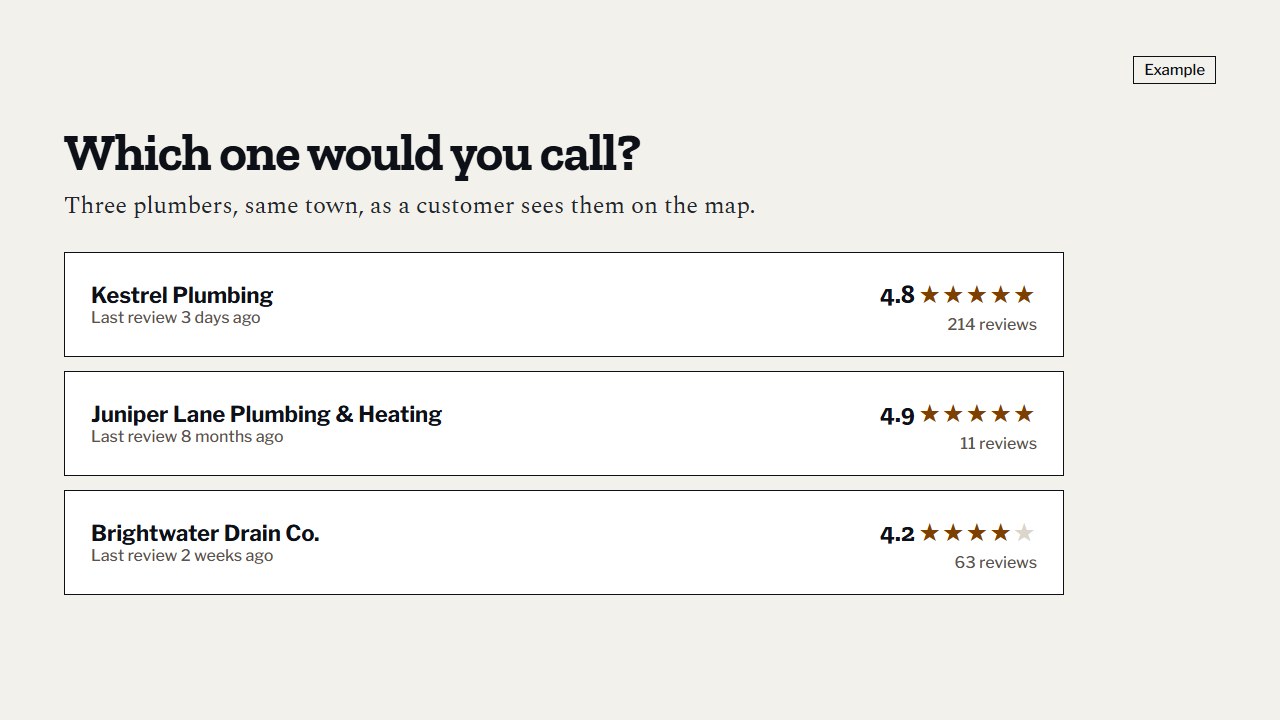
You’ve got 31 Google reviews and a 4.8. You’re proud of that, and you should be. Then you search “electrician” in your own town and the top three on the map have 140, 290 and 610.
So is 31 good or bad? Both. It depends on what the customer compares you to, and on the map they always compare you to the companies right next to you.
Short answer
Google doesn’t set a number. Get past 20 reviews first, because almost half of customers won’t use a business with fewer. After that, your real target is the top three companies on the map for your trade and town: get within reach of them, and keep new reviews coming every month, because 74% of customers look for reviews from the last three months.
of consumers won’t use a business with fewer than 20 reviews. Only 9% will use one with five or fewer (BrightLocal Local Consumer Review Survey, February 2026, 1,002 US adults).
What Google says
Google’s help page on local ranking says results are based on three things: relevance (how well your profile matches the search), distance (how far you are from the searcher) and prominence (how well known you are).
Reviews fall under prominence. Google’s words: “More reviews and positive ratings can help your business’s local ranking.” That’s it. Google gives no magic number and doesn’t say how much reviews weigh against everything else. Anyone quoting “the number Google wants” is guessing.
What customers say
Customers are clearer than Google. BrightLocal’s 2026 survey of US adults found:
- 47% won’t use a business with fewer than 20 reviews.
- 68% will only use a business rated 4 stars or more, and 31% want 4.5 or more.
- 74% look for reviews written in the last three months.
So the first goal is plain: 20 reviews, above 4.5, with some from this season. Below that, a big chunk of customers pass on you before they read a word.
What the experts think
Whitespark’s 2026 Local Search Ranking Factors report asked 47 local search experts to rank the factors behind showing up in Google Maps. It’s their opinion, not Google’s, but it’s the best survey we have. Review factors near the top:
- High Google star ratings (4–5 stars): 6th.
- Number of Google reviews with written text: 9th.
- Recency of reviews: 11th.
- A steady flow of reviews over time, rather than bursts: 14th.
Notice that three of those four aren’t about the total count. Rating, freshness and a steady pace matter as much as the pile.
The first reviews do the heavy lifting
Northwestern University’s Spiegel Research Center looked at online shopping data and found that a product with five reviews was 270% more likely to be bought than one with none. After the first five, the extra boost from each new review shrank fast.
That was online products in 2017, not contractor calls, so take it as a pattern, not a rule. The pattern makes sense though. Going from zero to a handful of reviews turns you from “who?” into “real business.” After that, more reviews mostly help you hold your own against competitors.
Why reviews carry this much weight in the first place is its own story. We cover it in the psychology of Google reviews.
Find your own number in 10 minutes
This is the part most articles skip. Your target isn’t a national average. It’s the three companies a customer sees next to you.
- Search like a customer. On your phone, in the middle of your service area, search your main service and town: “water heater repair Tustin,” “roof repair Plano.”
- Write down the top three on the map. For each: rating, review count, and the date of their newest review.
- Write down yours. Same three numbers.
- Pick a target. A fair goal for the next 12 months is the smallest of the three that still gets new reviews. Beating the leader can come later.
- Do the math. Target minus your count, divided by 12, is how many reviews you need each month.
A worked example
These are made-up numbers for an electrician, to show the math:
| Business | Rating | Reviews | Newest review |
|---|---|---|---|
| Competitor A | 4.6 | 610 | 2 days ago |
| Competitor B | 4.9 | 140 | 1 week ago |
| Competitor C | 4.4 | 290 | 5 months ago |
| You | 4.8 | 31 | 3 weeks ago |
Competitor C hasn’t had a review in five months, so it’s coasting. Of the two still active, Competitor B is smaller, with 140. Going from 31 to 140 in a year means about 9 new reviews a month.
If you finish 40 jobs a month and one customer in four leaves a review, that’s 10 a month. Doable, as long as you ask every single customer.
Would you rather have someone run this comparison for you? Our free audit puts your rating and review count next to your nearest competitors’ review counts.
Why the count isn’t everything
A big number doesn’t win on its own. Three things can beat it:
- Distance. Google weighs how far you are from the searcher. A 600-review company across the county won’t always beat a 60-review company down the street.
- Freshness. 290 reviews with nothing new since spring looks like a business that slowed down.
- Replies. Customers notice owners who answer. BrightLocal found 89% expect a response. Our guide to replying to a bad Google review shows how.
Reviews are one part of showing up on the map. The rest, like categories and your service area, is in how to rank in Google Maps.
Don’t take the shortcut
When the gap looks big, someone will offer to sell you 100 reviews. Don’t. Google bans paid reviews and any reward for reviews, and the FTC’s 2024 rule bans buying fake or sentiment-based reviews. A sudden pile of reviews also looks odd next to your normal pace.
The slow way is the only way that lasts: ask every customer, every job. Our scripts for asking for Google reviews make it a 20-second habit.
Do this this week
- Search your main service and town on your phone. Write down the top three’s rating, count and newest review date.
- Pick your 12-month target and divide the gap by 12.
- Count how many jobs you finish a month. Is your monthly target realistic if you ask everyone?
- Start asking every customer for a Google review this week.
- Check again in 30 days and see if you’re on pace.
Questions owners ask
Is there a minimum number of Google reviews?
Google doesn’t set one. Customers do: BrightLocal’s 2026 survey found 47% won’t use a business with fewer than 20 reviews. Treat 20 as your first milestone.
How many reviews do I need to show up in the map pack?
There’s no fixed number. Google says more reviews and positive ratings can help, along with relevance and distance. Look at the top three for your search and aim to get within reach of them.
What matters more, review count or star rating?
Both, and freshness too. Most customers won’t consider a business under 4 stars, and many look only at the last three months. A strong rating with steady new reviews usually beats a big old pile.
Do old reviews still count?
They stay on your profile, but customers care most about recent ones. 74% of people in BrightLocal’s survey look for reviews from the last three months.
Your number, this week
Do the ten-minute search tonight and write your target on the shop whiteboard. A number everyone can see gets hit more often than one in your head.
If you want help, start with our free audit, and see what we offer after that on our packages page.
Sources
- BrightLocal, “Local Consumer Review Survey 2026,” 11 February 2026, 1,002 US adults. brightlocal.com/research/local-consumer-review-survey
- Google Business Profile Help, “Tips to improve your local ranking on Google,” read 12 November 2026. support.google.com/business/answer/7091
- Whitespark, “2026 Local Search Ranking Factors,” 6 November 2025, survey of 47 local search experts. whitespark.ca/local-search-ranking-factors
- Spiegel Research Center, Northwestern University, “How Online Reviews Influence Sales,” first published June 2017. spiegel.medill.northwestern.edu/how-online-reviews-influence-sales
- Google Maps, “Prohibited & restricted content” (user contributed content policy), read 12 November 2026. support.google.com/contributionpolicy/answer/7400114
- Federal Trade Commission, “Federal Trade Commission Announces Final Rule Banning Fake Reviews and Testimonials,” 14 August 2024. ftc.gov press release