
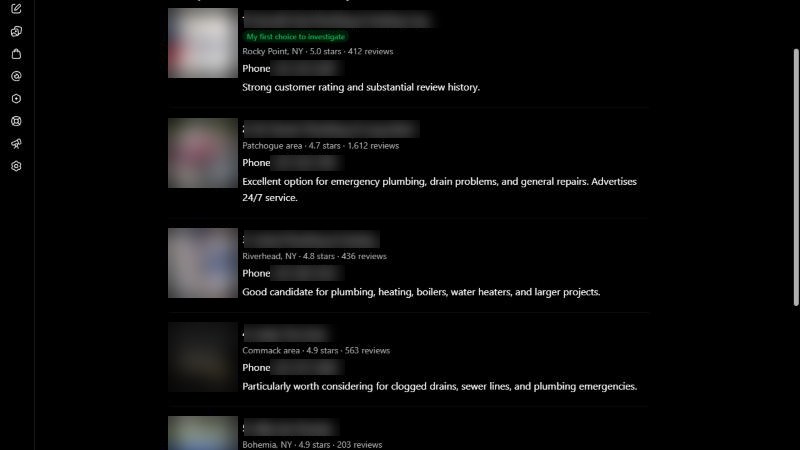
Picture a homeowner with water on the kitchen floor. Ten years ago they typed “plumber near me” into Google. Today a lot of them open ChatGPT and type a full question: “My kitchen sink is leaking under the cabinet, who should I call in Tustin?”
ChatGPT answers with a short list of names. Usually about four. If you are not one of them, that customer never sees you. There is no page two.
So the real question for a business owner is simple: where does ChatGPT get those names? We read what OpenAI says, what the biggest local search studies found, and the news from this year. Here is what we know, in plain words.
of US consumers used AI tools like ChatGPT to find local business recommendations, up from 6% a year earlier (BrightLocal Local Consumer Review Survey, February 2026, 1,002 US adults).
Short answer: ChatGPT does not have its own map of businesses
Google has Google Maps. It knows your hours, your reviews and your service area because you (or someone) filled in your Google Business Profile.
ChatGPT has nothing like that of its own. As of November 2026 there is no ChatGPT business listing you can claim. Instead, when someone asks a local question, ChatGPT goes looking. It pulls from three main places:
- Search partners. OpenAI says ChatGPT “sometimes partners with other search providers.” It rewrites the customer’s question into a search, like “emergency plumber Tustin,” and sends it to a partner. The privacy notice OpenAI points to for this is Microsoft’s, which runs Bing.
- Yelp. In July 2026 Yelp agreed to license its reviews, ratings, photos and business details to OpenAI, so they can show up inside ChatGPT answers with Yelp’s name and link.
- Your own website, and other sites that mention you. In BrightLocal’s study of about 200,000 AI searches, 93% of the different websites AI tools cited for local businesses were the businesses’ own sites, and those sites made up 42% of all citations.
One more thing matters: where the customer is. ChatGPT guesses a rough location from the customer’s internet connection and adds the city to its search. So it is looking for businesses that clearly say they work in that city.
1. Search partners: why Bing matters again
For years most owners ignored Bing. That made sense when almost nobody used it. It makes less sense now.
OpenAI’s help page says that when ChatGPT searches the web, it often hands a rewritten search to a partner, and for location questions it adds the city it thinks you are in. Its example: “good restaurants near me” becomes “top restaurants San Francisco.” For more details on how those searches are handled, it sends you to Microsoft’s privacy statement. Microsoft runs Bing.
What this means for you: if Bing can’t find a clear page that says what you do and where you do it, that search has nothing about you to return.
Two cheap fixes:
- Claim Bing Places for Business. It is free, and it puts your business details straight into the Bing index those searches use.
- Let OpenAI’s crawler read your website. OpenAI says a site is eligible to show up in ChatGPT search only if it lets “OAI-SearchBot” crawl it. Most small sites allow it already. Some security settings and website builders block it without telling you. It takes a web person five minutes to check.
2. Yelp: the one directory you can’t skip any more
A lot of contractors gave up on Yelp. Some hated the sales calls. Some got a bad review they couldn’t remove. That is understandable.
But in July 2026, Yelp and OpenAI made a deal: ChatGPT can now show Yelp reviews, ratings, photos and business details in its answers. The two companies also plan to bring Yelp’s “Request a Quote” button into ChatGPT, so a customer could ask you for a quote without leaving the chat. That part was announced as coming, not live.
BrightLocal’s AI study points the same way. Across ChatGPT and Google’s AI together, Yelp made up nearly 1 in 10 of all the sources cited, and a Yelp page showed up for about 85% of the businesses in the study. (The study does not give a ChatGPT-only Yelp number.)
You don’t need to pay Yelp for ads to be in this data. You need:
- A claimed Yelp page with your real business name, phone and website.
- The right categories and services, and the cities you actually serve.
- A few real photos of your work, your van, your team.
- Some recent reviews. Yelp’s rules say not to ask customers for Yelp reviews, so don’t. Ask for Google reviews instead, and let Yelp reviews come on their own.
3. Your own website does more work than you think
Here is the number that surprised us most. In BrightLocal’s study, 93% of the different websites AI tools quoted for local businesses were the businesses’ own sites. Those sites made up 42% of all citations. Directories like Yelp were big sources too, but the long list was mostly real business websites.
That makes sense once you think like ChatGPT. It is trying to answer “who fixes leaks in Tustin, today?” The easiest proof is a page that says, in plain words: “We fix leaks in Tustin. Same-day service. Licensed in California, license #123456.” If your site only says “Quality workmanship since 1998,” ChatGPT has nothing to match.
What helps:
- One page per main service. “Water heater repair,” “Drain cleaning,” “Repiping.” Not one long “Services” page.
- The cities you serve, said out loud. If you serve five cities, list them. If one city brings in a lot of work, give it its own page with real jobs you did there. Never the same page with only the city name swapped. Google treats that as spam.
- Plain facts AI can quote: license number, years in business, whether you do emergencies, your hours, which brands you install. Facts get quoted. Slogans don’t.
- Answers to real questions your customers ask on the phone: “Do you charge to come out?” “Do you work weekends?” Put them on the site in their words.
What about my Google Business Profile?
Keep it. It is still the most important thing for Google, and Google has its own AI answers now (AI Overviews and AI Mode). In BrightLocal’s study, Google profiles made up about 29% of all the sources cited across the three AI tools they tested, and the study says Google’s own AI leans on them heavily.
But the same study found Google profiles are “hardly used by ChatGPT.” That is the big change. Being perfect on Google no longer means you are covered everywhere. ChatGPT reads the open web, Bing and Yelp instead.
The 5-step checklist
- Ask ChatGPT, in a fresh chat, the question your customers would ask: “Who is a good [your trade] in [your city]?” Write down who it names. Try it again on another day; the list changes.
- Claim and fill in your Yelp page: categories, services, cities, photos.
- Claim Bing Places. Copy your Google profile across.
- Make sure your website has one page per main service, lists the cities you serve, and states your license number and hours in plain text.
- Check that your website lets OAI-SearchBot in. Ask whoever runs your site, or ask us.
Don’t expect to be named every time
AI answers move around. In BrightLocal’s study, a business that showed up once in ChatGPT came back in only about half of the repeat searches. Ask the same question twice and you often get a different list. ChatGPT names about four businesses per answer, and about one answer in ten named nobody at all.
So nobody can promise you a spot in ChatGPT. Anyone who does is guessing. What you can do is give it more true, clear, matching information about you in more places, so you come up more often. That is the same work that helps you on Google, Bing and Apple Maps too.
Where to start this week
Do step 1 of the checklist today. It takes two minutes and it is free. If your competitors get named and you don’t, you now know why, and you know what to fix first.
If you want a second pair of eyes, we run this exact check as part of our free audit. We ask ChatGPT, Gemini and Perplexity about your trade and city, and show you the screenshots. You can see what we offer after that on our packages page.
Sources
- BrightLocal, “Local Consumer Review Survey 2026,” 11 February 2026, 1,002 US adults. brightlocal.com/research/local-consumer-review-survey
- BrightLocal, local AI visibility study (about 200,000 non-branded searches in ChatGPT, Google AI Mode and AI Overviews, about 1.9 million citations), 16 September 2026. brightlocal.com/research/local-ai-visibility-study
- OpenAI Help Center, “Searching the web with ChatGPT,” read 12 November 2026. help.openai.com/en/articles/9237897
- MarTech, “Yelp brings reviews and local leads to ChatGPT,” 28 July 2026 (reporting Axios’s 23 July 2026 story). martech.org/yelp-brings-reviews-and-local-leads-to-chatgpt