
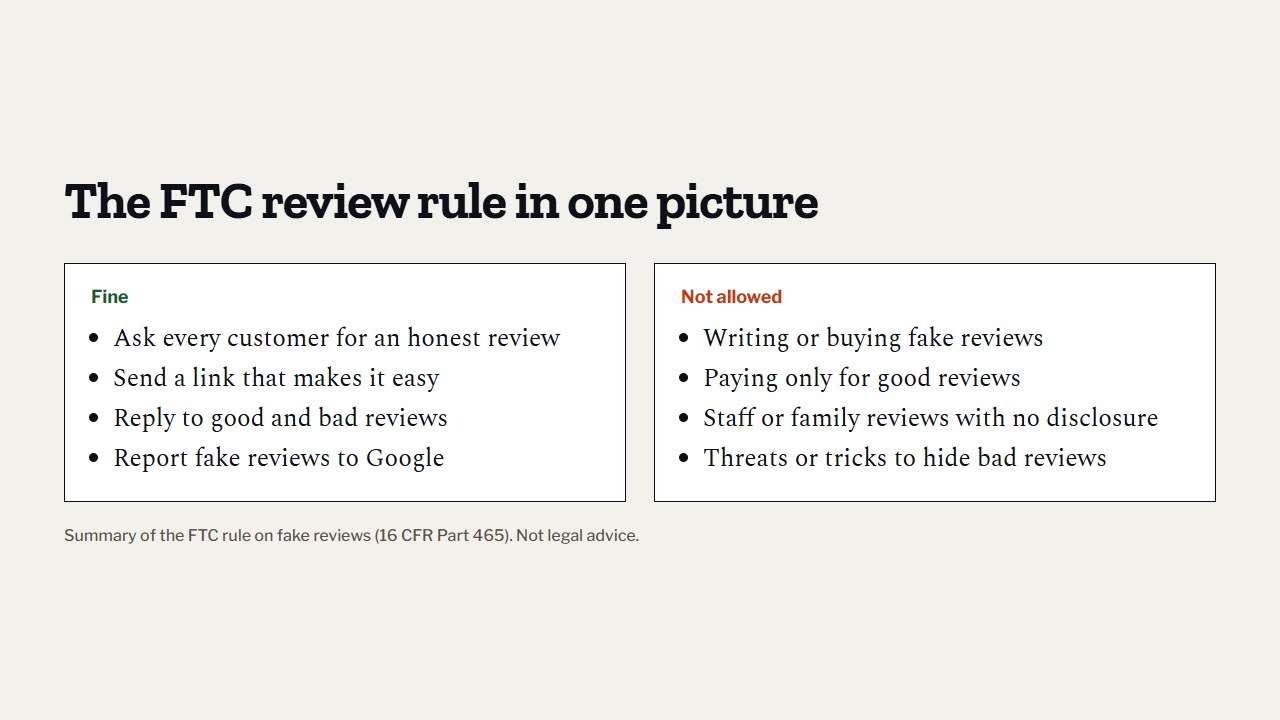
The email lands on a Tuesday: “Boost your Google rating! 50 five-star reviews from real accounts, 100% safe, only a few dollars each.” Your rating is a 4.3 and the guy across town has 400 reviews. It’s tempting for about three seconds.
Here’s why to hit delete. Buying reviews used to risk your Google profile. Now it can also bring the Federal Trade Commission to your door.
This is a plain-English summary of the FTC rule, written for owners, not lawyers. It is not legal advice. If you have a specific situation, check with your lawyer for your case.
Short answer
The FTC’s Consumer Reviews and Testimonials Rule took effect on 21 October 2024 and bans fake reviews (including AI-written ones), paying for positive or negative reviews, undisclosed reviews by owners and managers, fake “independent” review sites, scaring people into removing bad reviews, and fake followers. The FTC can ask courts for civil penalties for knowing violations. Google’s own rules are stricter on rewards and on who you ask, so the safe path is simple: ask every customer, reward no one, fake nothing.
What the rule is, in one paragraph
The FTC announced the final rule on 14 August 2024, after a 5–0 vote. The agency said it wanted to stop fake reviews, including ones written by AI, and that handling cases one by one without fines “might not be enough to deter” them. The rule went into effect on 21 October 2024.
The six things it bans
1. Fake reviews
No reviews from people who don’t exist, or who never used your business. That includes reviews made up by AI. You can’t write them, buy them, or share them when you knew or should have known they were fake.
Contractor version: your nephew writing three glowing reviews under different names.
2. Buying positive or negative reviews
You can’t offer money or anything else in return for a review that says something positive, or a negative review about a competitor. The deal doesn’t have to be spelled out. An implied “we’ll take care of you for five stars” counts.
Contractor version: “$25 off your next service call for a 5-star review.”
3. Insider reviews without disclosure
Reviews from owners, managers, employees or agents have to clearly say who wrote them. Owners and managers have extra limits, including when they ask family or staff to post reviews.
Contractor version: your office manager reviewing the company from her personal account without saying she works there.
4. Fake “independent” review sites
You can’t run a site that claims to give neutral reviews of, say, “the best roofers in Phoenix” when you own one of the roofing companies on it.
5. Review suppression
You can’t use baseless legal threats, physical threats, intimidation or certain false public accusations to stop or remove a bad review. You also can’t claim the reviews you show are all or most of your reviews when you’ve hidden the bad ones.
Contractor version: “Take that review down or you’ll hear from my lawyer,” when there’s no real legal claim.
6. Fake social media numbers
No buying or selling fake followers or views (from bots or hijacked accounts) to look more popular for business, when you knew or should have known they were fake.
is the maximum civil penalty per violation of an FTC rule, set in the FTC’s 2025 inflation adjustment and left unchanged for 2026 (FTC, February 2025 and September 2026). Courts can impose penalties for knowing violations.
What the rule doesn’t ban
The FTC’s own question-and-answer guide for businesses makes a few things clear:
- You can ask customers for reviews. Nothing in the rule stops an honest request.
- You can reply publicly to a bad review. The FTC says yes, you can respond publicly. Just don’t make false accusations or threats.
- You can contact an unhappy customer to fix the problem.
- Employees can review you, if they clearly say they work for you.
Two areas are trickier, and this is where most articles get it wrong.
Rewards for any review. Under the FTC rule, an incentive that doesn’t depend on the review being positive isn’t automatically banned. But Google bans every incentive for reviews, positive or not. So for Google reviews, the answer is still no.
Asking only happy customers. The FTC’s guide says the rule has no specific ban on this (it’s called review gating). It adds that other parts of the FTC Act and its Endorsement Guides may still apply. Google, though, bans it outright: its policy says businesses can’t “selectively solicit positive reviews.”
Not sure whether your current review requests pass both sets of rules? Our free audit shows your rating and review count next to your nearest competitors’ review counts, so you can see the gap an honest, steady flow of reviews needs to close.
FTC rule vs. Google’s rules
For a contractor, Google’s policy is the stricter one, so it’s the one to plan around.
| Practice | FTC rule | Google policy |
|---|---|---|
| Fake or AI-made reviews | Banned | Banned |
| Reward for a 5-star review | Banned | Banned |
| Small reward for any honest review | Not banned by the rule if not tied to a positive review | Banned |
| Asking only happy customers | No specific ban in the rule; other FTC law may apply | Banned |
| Staff reviewing the business | Allowed only with clear disclosure | Conflict of interest, not allowed |
| Pushing someone to remove a bad review | Threats, intimidation and certain false accusations banned | Offering anything to remove it banned |
What to check in your business this week
- Your review request wording. Remove anything like “if you were happy” or “leave us 5 stars.” Our guide to asking for Google reviews without being pushy has rule-safe scripts.
- Any discount or raffle tied to reviews. Stop it.
- Reviews from your crew. If they’re on your Google profile, ask them to take them down. Google’s policy lists employment as a conflict of interest. And if you’ve asked relatives to post reviews, know that the FTC rule puts extra limits on owners and managers who do that.
- Your vendors. If a marketing company collects reviews for you, ask in writing how they do it. If they filter out unhappy customers or pay for reviews, it’s your business name on those reviews.
- How you reply to bad reviews. No threats, no “we know who you are.” Use our examples in how to reply to a bad Google review.
Customers care about this too. In BrightLocal’s 2026 survey, 97% said businesses that post fake reviews should face consequences. The rule just puts the government on their side.
For the bigger picture of why honest reviews work so well in the first place, read the psychology of Google reviews.
Do this this week
- Read your review request text, invoice footer and website for “happy,” “5 stars” or any reward. Fix it.
- Send the same review request to every customer, not just the ones who smiled.
- Check your profile for reviews from staff or family. Ask them to remove them.
- Ask anyone who handles reviews for you exactly how they get them.
- Delete the next “buy reviews” email without replying.
Questions owners ask
Is review gating illegal?
The FTC rule has no specific ban on it, though the FTC says other parts of the FTC Act may still apply. Google bans it outright, so asking only happy customers can get your Google reviews removed. Check with your lawyer for your case.
Can I give a discount for leaving a review?
Not for a Google review. Google prohibits any incentive for reviews. Under the FTC rule, a reward that depends on a positive review is banned.
Can my employees leave Google reviews for my business?
The FTC rule allows it only if they clearly say they work for you. Google treats employee reviews as a conflict of interest, so it’s safest not to have them review you on Google at all.
What is the fine for fake reviews?
The rule lets courts impose civil penalties for knowing violations. The FTC’s 2025 adjustment set the maximum at $53,088 per violation, and the FTC kept it the same for 2026. What a court actually orders depends on the case.
When did the FTC fake review rule take effect?
On 21 October 2024. The FTC announced it on 14 August 2024.
The honest way is also the easy way
Ask every customer, reward nobody, fake nothing, and answer every review politely. That’s the approach both the FTC rule and Google’s policy point toward. For your own case, check with your lawyer.
If you’d like a second pair of eyes on your reviews and how you collect them, start with our free audit. You can see what we offer after that on our packages page.
Sources
- Federal Trade Commission, “Federal Trade Commission Announces Final Rule Banning Fake Reviews and Testimonials,” 14 August 2024. ftc.gov press release
- Federal Trade Commission, “Consumer Reviews and Testimonials Rule: Questions and Answers,” read 12 November 2026. ftc.gov business guidance
- Federal Trade Commission, “FTC Publishes Inflation-Adjusted Civil Penalty Amounts for 2025,” 11 February 2025. ftc.gov press release
- Federal Trade Commission, “Civil Penalty Inflation Adjustments” (no change for 2026), Federal Register Vol. 91, No. 177, 15 September 2026. govinfo.gov FR Doc. 2026-18853
- Google Maps, “Prohibited & restricted content” (user contributed content policy), read 12 November 2026. support.google.com/contributionpolicy/answer/7400114
- Google Business Profile Help, “Tips to get more Google reviews,” read 12 November 2026. support.google.com/business/answer/7035772
- BrightLocal, “Local Consumer Review Survey 2026,” 11 February 2026, 1,002 US adults. brightlocal.com/research/local-consumer-review-survey